
For over twenty years, the forests of central Vietnam have been missing one of their most remarkable inhabitants. The Vietnam Pheasant, once native to the dense, humid lowland forests of the region, has not been reliably recorded in the wild for decades. Among its most striking characteristics is the male’s deep dark blue plumage with a subtle metallic sheen, which, together with its vivid red facial skin, gives the species a particularly elegant appearance. Its decline is the result of multiple pressures over time, including extensive habitat loss, agricultural expansion, illegal hunting, and the lasting ecological impacts of the Vietnam War, during which large areas of forest in its distribution range were severely degraded. As these pressures continued, the species gradually faded from its natural habitat – until it was eventually feared to be lost.
An international alliance of conservation organisations, zoological institutions, and Vietnamese partners has come together with a shared goal: to return the Vietnam Pheasant to the forests where it once lived. The project represents one of the few global efforts to reintroduce a species that is likely extinct in the wild, making it both an ambitious and deeply symbolic undertaking.
The survival of the Vietnam Pheasant into the present day is, in itself, a remarkable story. In the early 20th century, a small number of birds were brought from Vietnam to Europe. This tiny founder population became the basis of a carefully managed conservation effort across zoological institutions and private breeders. Over decades, through coordinated breeding programmes and international collaboration, the population grew and was maintained as a genetically viable assurance population.
Now, for the first time, that population is being used to support a return to the wild. This week, a group of pheasants selected from European breeding programmes will be transported from Berlin to Vietnam. Each individual has been carefully chosen based on genetic diversity, health, and behavioural characteristics, ensuring that the foundation of the future population is as strong as possible. The transfer itself marks a major milestone, but it is only the beginning of a long and carefully staged process.
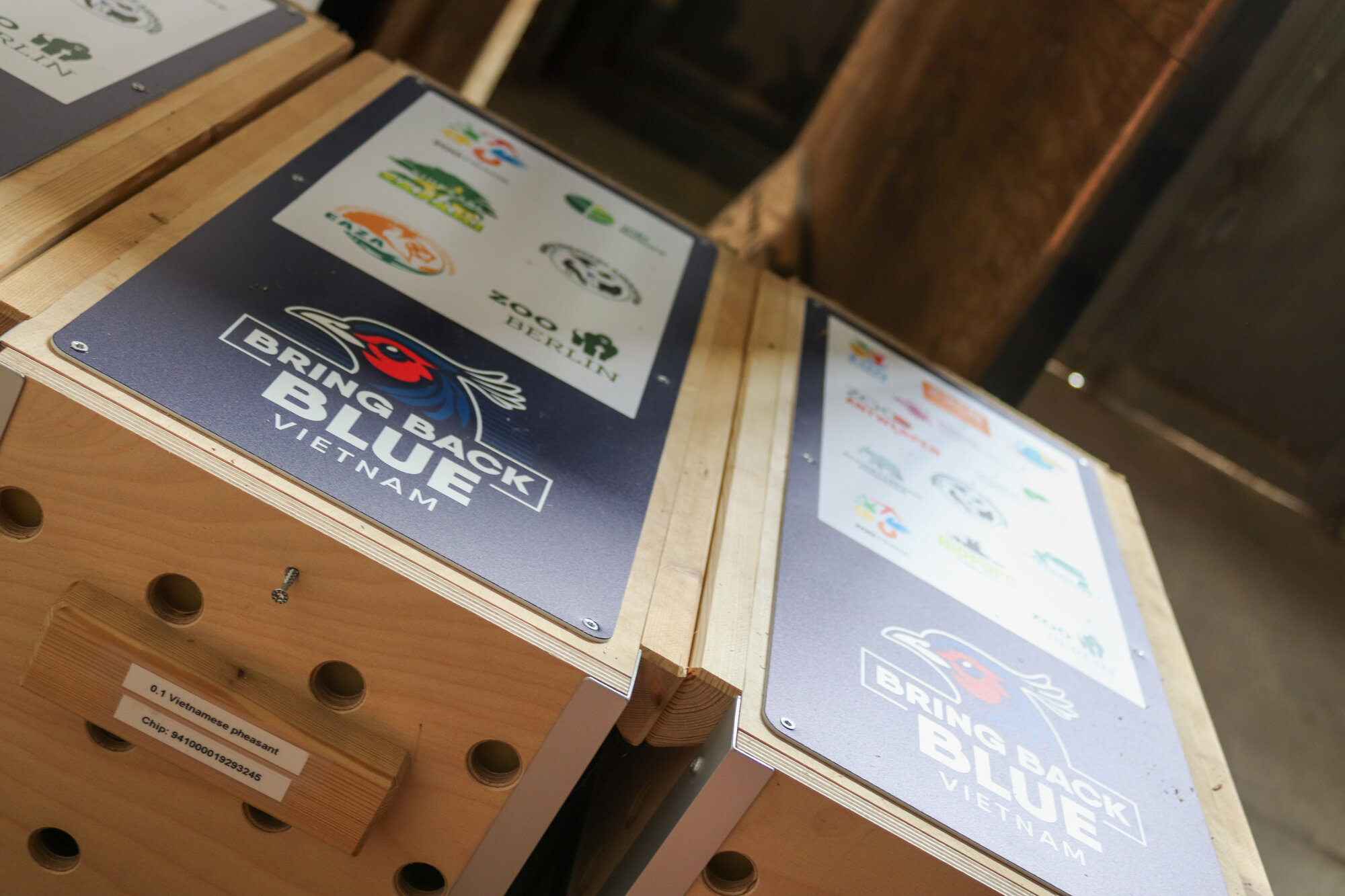
The selected 20 pheasants will be transported from Germany to Vietnam by cargo aircraft in specially designed transport crates that ensure safety, ventilation, and minimal stress throughout the journey. The transfer will be accompanied by experienced experts, who will monitor the birds continuously and ensure their well-being at every stage of the transport process.
Following their arrival, the birds will undergo a period of acclimatisation and observation under professional care. The immediate goal is not release, but stability: to allow the pheasants to adjust to local climatic conditions, to form breeding pairs, and to establish new, locally born, parent-reared generations. Only once this foundation is secure will further steps towards release be considered.
This approach reflects the complexity of the challenge. Reintroducing a species that may no longer exist in the wild requires more than simply returning animals to their former habitat. It requires functioning ecosystems, long-term protection, and the support of local communities.
In central Vietnam, these conditions are being developed in parallel. Within the historical range of the species, protected forest areas are being prepared as potential future release sites. Conservation teams are working on the ground to safeguard these habitats, monitor biodiversity, and reduce ongoing threats such as illegal hunting.
A central role in this effort is played by the Rare Pheasants Breeding Centre, operated by the local NGO Viet Nature Conservation Centre. As the first facility of its kind in Vietnam dedicated specifically to this species, the centre combines conservation breeding with research and environmental education, while also engaging local communities in protecting their natural heritage. “For Vietnam, the recovery of the Vietnam Pheasant is more than the return of a single species,” said Pham Tuan Anh, director of Viet Nature. “It represents our pride and responsibility in protecting our natural heritage. This project shows how conservation practitioners, scientists, local communities and authorities can come together to rebuild what has been lost.”
The initiative is supported by a wide network of partners, bringing together expertise in breeding management, veterinary science, habitat conservation, and long-term monitoring. Within this collaborative framework, the European Ex-situ Programme (EEP) plays a key role in ensuring the genetic health and long-term viability of the population.
“The coordinated management of the European population has been essential in preparing for this moment,” said Veronika Zahradníčková, the EEP Coordinator at Prague Zoo. “Through careful breeding and long-term genetic planning, we have been able to maintain a healthy and viable population. Contributing individuals to this reintroduction is a significant milestone and an important step towards restoring the species in its natural habitat.”
Building on this foundation of international cooperation, partner zoos have worked closely over many years to secure the survival of the species under human care and to enable its future return to the wild.
“This project is very close to our hearts here at Zoo Berlin. It is the result of decades of international cooperation,” said Dr Andreas Knieriem, Director of Zoo and Tierpark Berlin. “The Vietnam Pheasant has survived because of coordinated conservation breeding, and now we have the opportunity to take the next step: returning it to the wild where it belongs.”
“At Vinpearl Safari Phú Quốc, we see our role as building a strong regional hub for the Vietnam Pheasant. One that complements international efforts while ensuring the population is managed sustainably within its native range in central Vietnam. By establishing an additional secure breeding centre in Vietnam, we reduce risk, strengthen resilience, and create the conditions needed for a successful long-term recovery of this species in the wild,” said Lưu Chí Hiếu, General Manager of Vinpearl Safari Phú Quốc.
The importance of long-term commitment is also emphasized by global conservation partners working beyond Europe. “Very few species get a second chance like this,” said Jo Gregson, chair of the World Pheasant Association. “The Vietnam pheasant is a powerful example of how long-term conservation efforts can create real opportunities for recovery, even under the most difficult circumstances.”
The return of the Vietnam pheasant represents a rare opportunity to reverse a loss that once seemed final. It highlights the role that long-term conservation breeding can play in safeguarding species, and it demonstrates the importance of international collaboration in addressing global biodiversity challenges.