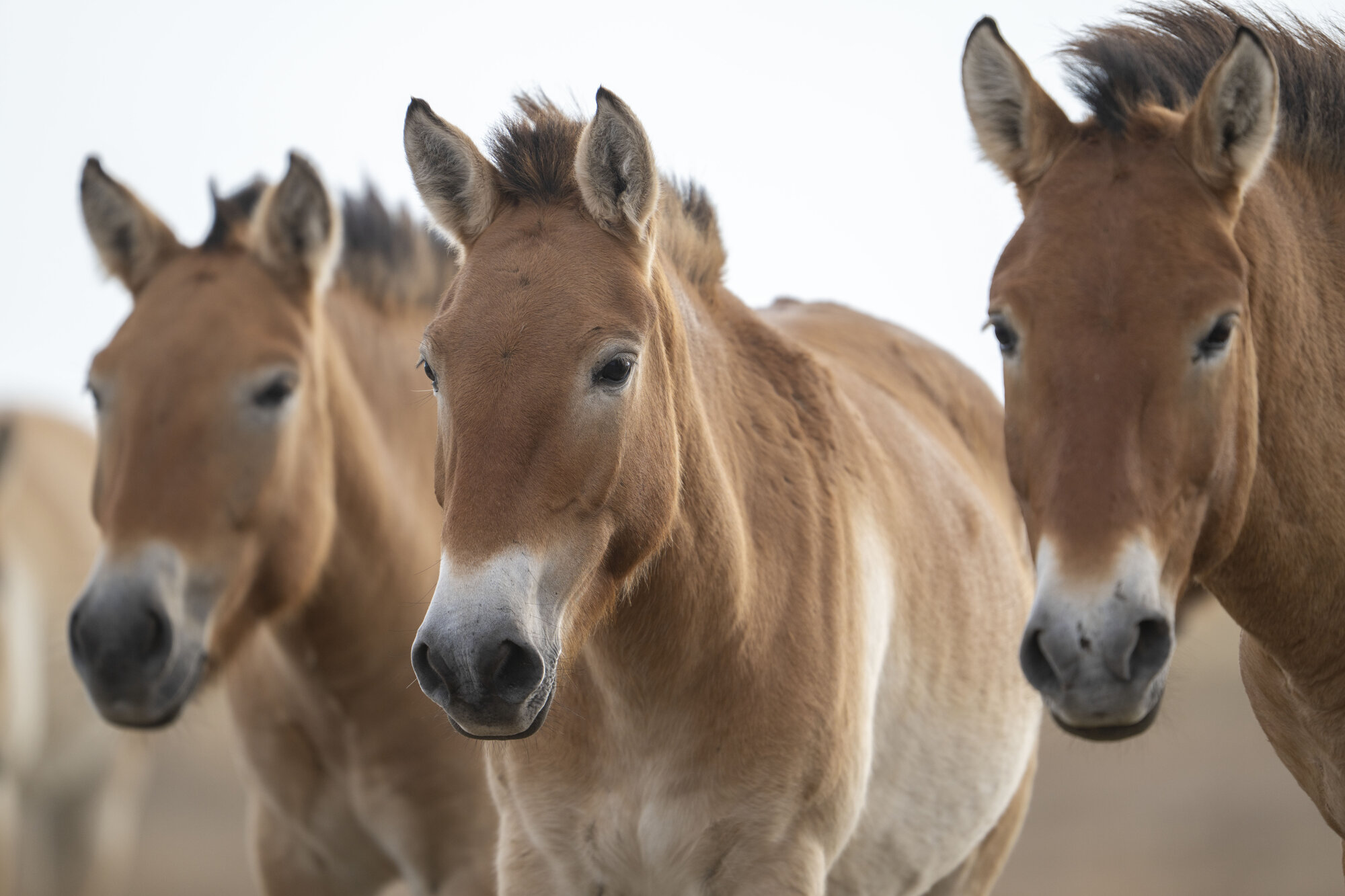
The reintroduction of the Przewalski’s horse in the Central Asian steppe continues to progress successfully. The horses transferred from Berlin to the “Altyn Dala” steppe in Kazakhstan in 2024 have settled in well. Together with other wild horses from European zoos within the framework of the international joint project “Return of the Wild Horses” led by Prague Zoo, they have formed the first herd in the region. Preparations are now underway in Berlin for the next transport: in late spring 2026, it is expected that four wild horses out of eight in total, will again start their journey to Kazakhstan in Berlin.
„Selecting individual horses for reintroduction in Kazakhstan from breeders all over Europe is – among other things – crucial for genetical variability of the restored population. Our task now is to prepare candidates and also substitute candidates for this demanding long-distance transport. The next step is gathering them at places that serve as a hub from where the transport itself will start again in spring. One of these places is the Prague Zoo breeding station in Dolní Dobřejov, which is located south of the Czech capital, and we are very happy that Tierpark Berlin will once again serve as the second hub as our previous cooperation proved to be more than successful,“ says Barbora Dobiášová, the Prague Zoo ungulate curator and also EEP coordinator for the Przewalski’s horses.
Once extinct in the wild and surviving only through a small number of individuals in human care, the Przewalski’s horse is now gradually returning to one of its original habitats. In the 1960s, wild populations were considered completely lost. Only coordinated international cooperation between zoos and conservation programs has preserved the species from total extinction.
“The fact that we can once again see wild horses in this ecologically important grass steppe today is the result of international and interdisciplinary cooperation, as well as decades of scientifically coordinated conservation breeding,” says Christian Kern, Zoological Director of Zoo Berlin and Tierpark Berlin. “The animals are very quickly showing their natural behavior in Kazakhstan. They roam wide areas in search of food and water, develop especially thick winter coats, and form the species-typical harem groups led by an adult stallion who guides and defends his group. These are very good signs.” In the steppe, the wild horses play an important ecological role: as large herbivores, Przewalski’s horses keep grasslands open, prevent shrub overgrowth, and contribute to reducing natural fuel loads for wildfires. Their grazing behaviour creates diverse vegetation patterns, benefiting insects, small mammals, and ground-nesting birds. In doing so, they actively help stabilize and regenerate the steppe ecosystem.
“With the return of the Przewalski’s horse, an ecological process that shaped these landscapes for millennia is coming back,” explains Stephanie Ward of the Zoological Society Frankfurt, which coordinates the project internationally. “The animals contribute to a functioning, resilient steppe ecosystem. A habitat that supports saiga antelopes, kulan, steppe eagles and many other species.”
The reintroduction of the wild horses to central Kazakhstan is a joint project of the Altyn Dala Conservation Initiative together with Prague Zoo, Tierpark Berlin, Nuremberg Zoo, and Hortobágy National Park. Veterinary oversight is provided by the Leibniz Institute for Zoo and Wildlife Research. The Return of the Wild Horses is not only a conservation success but also represents the restoration of an entire landscape. It is embedded in the Altyn Dala Conservation Initiative, which aims to restore the Kazakh grasslands ecosystems for nature and people. The project area stretches across more than 750,000 km² of steppes and semideserts, which represent one of the largest connected grassland biomes of our planet.
In 2024, “Altyn Dala” was awarded the prestigious Earthshot Prize in the category Protect and Restore Nature and is a flagship project of the UN Decade on Ecosystem Restoration. This international recognition highlights the initiative’s significance for global conservation and the long-term preservation of large, intact steppe ecosystems. An integral part of this mission, is the reintroduction of Przewalski’s horses.
Pictures: © Daniel Rosengren // ZGF